
Zero Trust SDLC is not a new security framework and not a replacement for Zero Trust architectures, IAM platforms, or CI/CD controls.
It is the application of Zero Trust principles—continuous validation, attribution, and least privilege—across the software development lifecycle.
In practice, Zero Trust SDLC is enabled by Developer Security Posture Management (DevSPM), which acts as the system of record linking scan results, vulnerabilities, and policy violations to developer and AI agent identity and actions across the SDLC.
This enables organizations to:
Continuously validate actions across development workflows
Attribute security findings to identity and behavior
Govern tools and integrations used throughout the SDLC
Preserve audit-ready evidence tied to how software was created
Without developer-aware visibility, Zero Trust programs cannot meaningfully extend into development.
Traditional Zero Trust implementations focus on access control and runtime enforcement. However, when risk is introduced during development, security teams often cannot answer:
How did this risk enter the SDLC?
Which commit, pull request, or tool introduced it?
Was the action human-driven or AI-assisted?
Is this behavior recurring across teams or repositories?
This lack of visibility leaves organizations exposed to:
Insider Threats. Compromised credentials or misuse of access can introduce risk long before deployment.
Shadow IT Across the SDLC. Unapproved developer tools, IDE plugins, or CI/CD integrations expand the attack surface without detection.
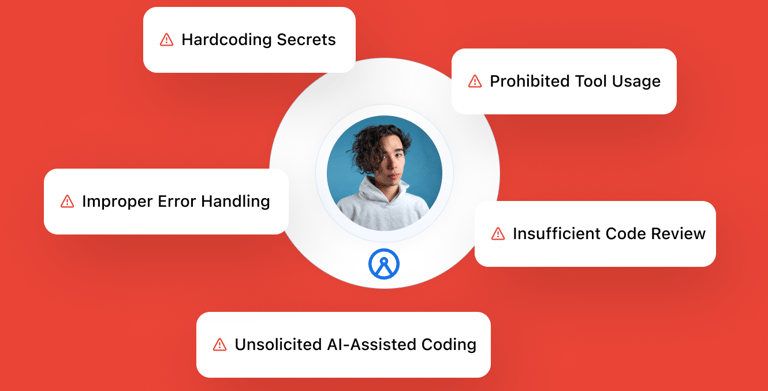
Risky Development Practices. Insecure dependencies, leaked secrets, or flawed AI-generated code can propagate silently through trusted workflows.
Zero Trust SDLC requires identity-aware telemetry to validate actions at the point where software risk originates.
Recent cybersecurity incidents underscore the necessity of adopting Zero Trust SDLC:
Insider Threats and Identity Weaknesses: In the Uber breach (2022), compromised developer credentials enabled unauthorized access to internal systems, exposing user data and illustrating the dangers of weak identity controls.
AI Code Vulnerabilities: Research in 2024 revealed AI-generated code suggestions from tools like GitHub Copilot occasionally introduced insecure solutions if your existing codebase already contains security issues. Zero Trust SDLC enforces stringent checks to ensure the reliability of AI-assisted development.
Archipelo enables Zero Trust SDLC by making actions across the SDLC observable—human and AI—through Developer Security Posture Management.
Archipelo creates a historical record of coding events across the SDLC tied to developer identity and actions, providing the attribution and context required for continuous validation.
Key Capabilities:
Developer Vulnerability Attribution
Trace scan results and vulnerabilities to the developers and AI agents who introduced them.Automated Developer & CI/CD Tool Governance
Scan developer and CI/CD tools to verify tool inventory and mitigate shadow IT risks across the SDLC.AI Code Usage & Risk Monitor
Monitor AI code tool usage to ensure secure and responsible software development.Developer Security Posture
Generate insights into security risks introduced by actions across teams and workflows.
These capabilities provide the foundation required to apply Zero Trust principles throughout the SDLC—without redefining existing Zero Trust architectures.
Zero Trust SDLC is not achieved through blanket restrictions or reactive controls.
It is achieved by ensuring that every action within the SDLC is attributable, auditable, and governable.
By enabling Developer Security Posture Management, organizations can:
Validate actions across development workflows
Reduce investigation time through identity-based attribution
Strengthen compliance evidence
Address root cause instead of recurring symptoms
Archipelo strengthens existing ASPM and CNAPP stacks with developer-level observability and telemetry—enabling Zero Trust outcomes where software risk actually enters the SDLC.
Contact us to learn how Archipelo strengthens your existing ASPM and CNAPP stack with Developer Security Posture Management.